Introducing PMHNP Finds: Practical Guides for Building Your Psychiatric NP Practice
October 20, 2026
From the team at AKW Associates — helping psychiatric nurse practitioners build practices that thrive.
When we started building our own telehealth psychiatric practice in Maryland, we kept running into the same problem: the information we needed existed, but it was scattered across board websites, payer portals, IRS publications, and a lot of trial and error. Nobody hands you a map for going from “I’m a PMHNP” to “I own a practice that’s credentialed, compliant, and financially healthy.”
So we made the map. Today we’re excited to announce PMHNP Finds, our new Etsy shop of practical, downloadable guides for psychiatric nurse practitioners who want to launch, credential, and grow their own practice.
Why we built these guides
Most practice-building advice for nurse practitioners is either too generic to act on or buried in a two-hour webinar. We wanted something different: guides you can open on a Tuesday night and actually work through, one step at a time.
Every guide is built on four promises:
- Built from real operations. Written from running a Maryland telehealth psychiatric practice, not from theory.
- Practical, not generic. Steps in order, worked examples, checklists, and templates.
- Dated and updated. Every edition is dated and refreshed as rules change. The current editions are updated for 2026.
- Honest about limits. These are educational guides. We tell you when it’s time to bring in your attorney, CPA, or Board of Nursing.
Clinical content is reviewed by Anne Dalton, MSN, CRNP, PMHNP-BC, PMH-C.
Meet the guides
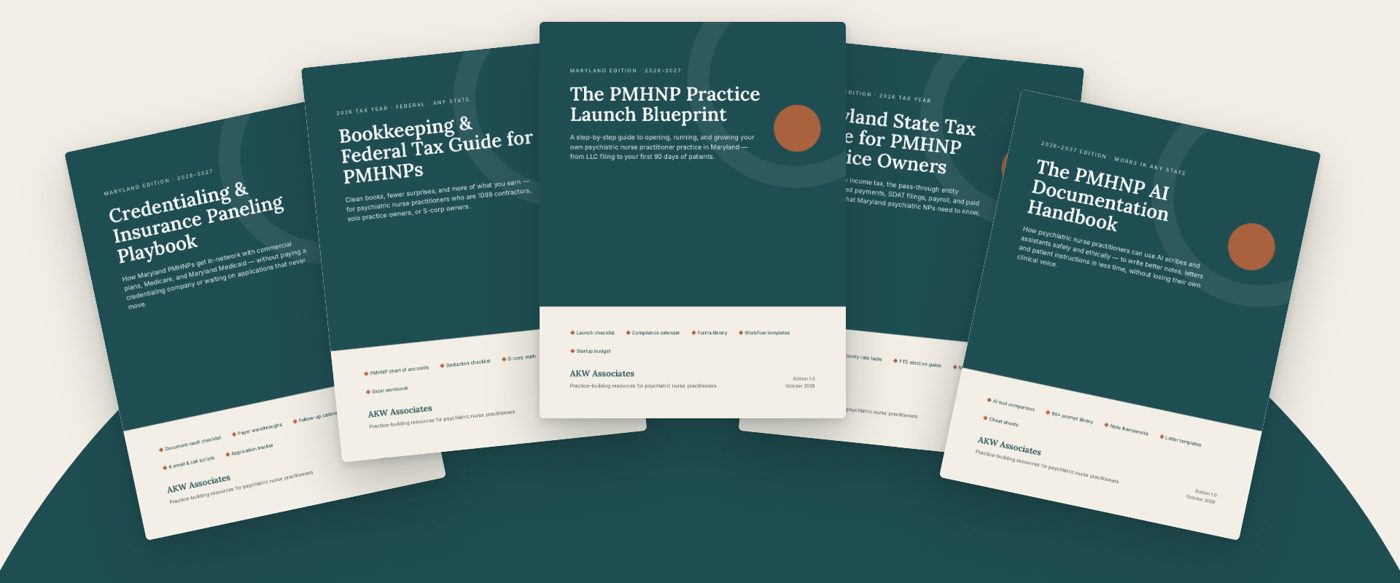
1. The PMHNP Practice Launch Blueprint
Maryland edition, 2026–2027
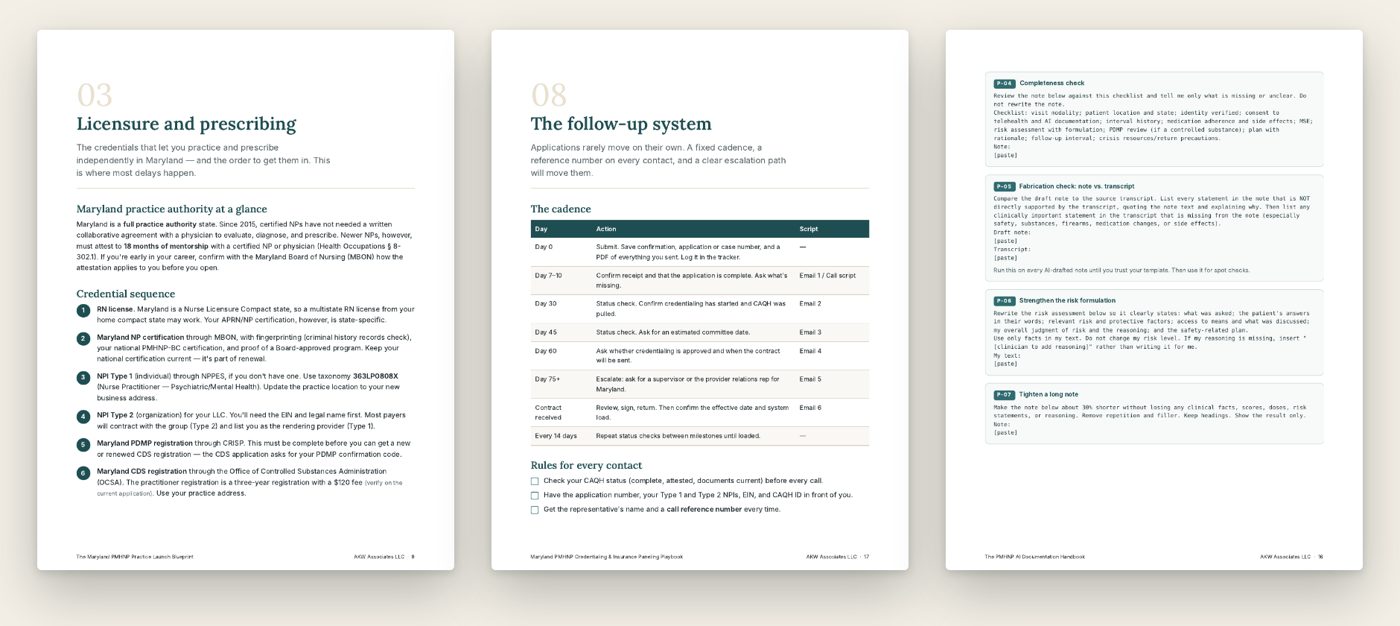
A step-by-step guide to opening, running, and growing your own psychiatric nurse practitioner practice in Maryland, from filing your LLC to your first 90 days of patients. It walks through licensure and prescribing in the order that avoids the most common delays: Maryland practice authority, NP certification, NPI Type 1 and Type 2, PDMP registration, and CDS registration.
Includes: launch checklist, compliance calendar, forms library, workflow templates, and a startup budget.
2. Credentialing & Insurance Paneling Playbook
Maryland edition, 2026–2027
How Maryland PMHNPs get in-network with commercial plans, Medicare, and Maryland Medicaid, without paying a credentialing company or waiting on applications that never move. The heart of the playbook is a follow-up system: a fixed cadence from submission through contract, a reference number on every contact, and a clear escalation path.
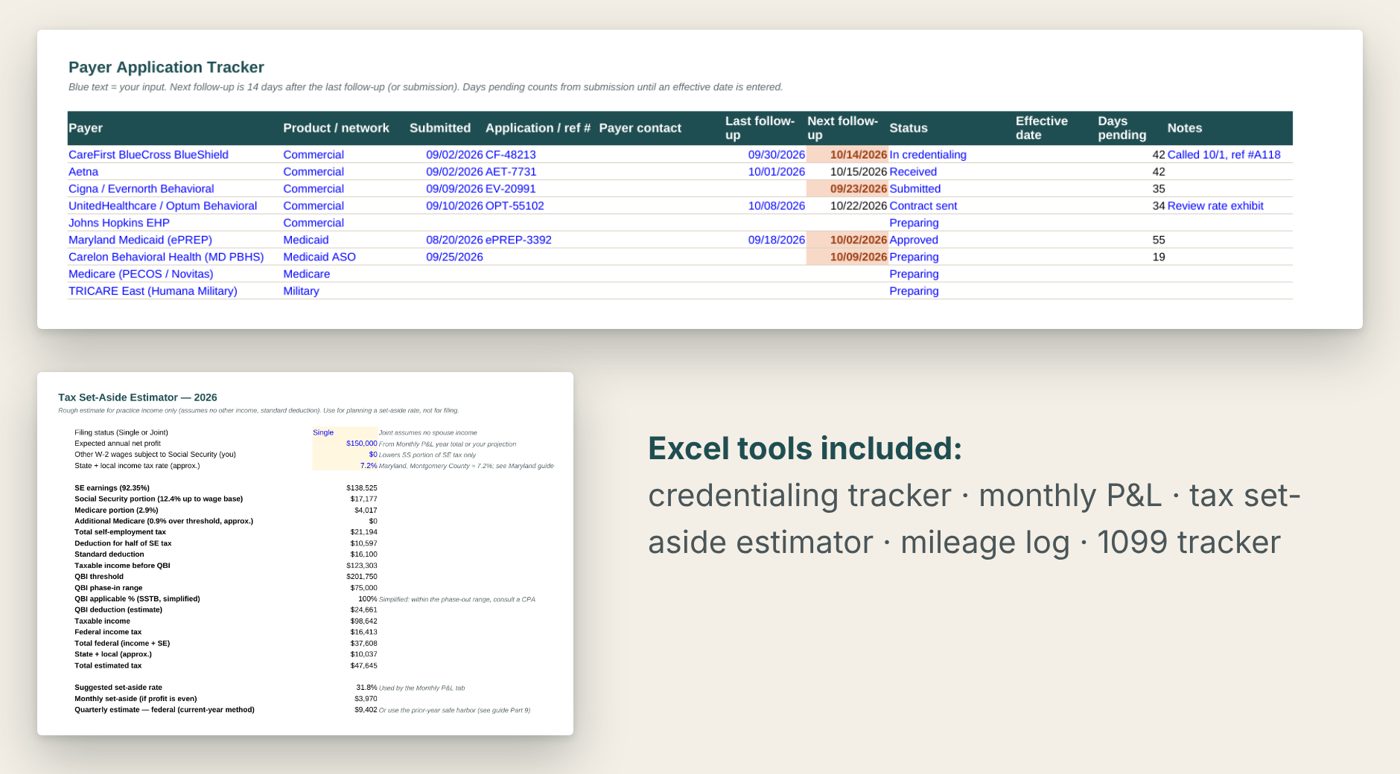
Includes: a document vault checklist, payer walkthroughs, six email and call scripts, and an Excel payer application tracker that calculates your next follow-up date and days pending.
3. Bookkeeping & Federal Tax Guide for PMHNPs
2026 tax year, federal, works in any state
Clean books, fewer surprises, and more of what you earn, whether you’re a 1099 contractor, a solo practice owner, or an S-corp owner.
Includes: a PMHNP chart of accounts, a deduction checklist, S-corp math, and an Excel workbook.
4. Maryland State Tax Guide for PMHNP Practice Owners
2026 tax year
The Maryland side of the picture: state income tax, the pass-through entity (PTE) election, estimated payments, SDAT filings, and payroll.
Includes: a county rate table and a PTE election guide.
5. The PMHNP AI Documentation Handbook
2026–2027 edition, works in any state
How psychiatric nurse practitioners can use AI scribes and assistants safely and ethically to write better notes, letters, and patient instructions in less time, without losing their own clinical voice. The prompt library includes quality checks such as a completeness review and a fabrication check that compares a draft note against its source transcript.
Includes: an AI tool comparison, a library of 60+ prompts, note frameworks, letter templates, and cheat sheets.
Tools that do the math
Several guides come with Excel tools so you’re not starting from a blank spreadsheet:
- Credentialing tracker
- Monthly P&L
- Tax set-aside estimator
- Mileage log
- 1099 tracker
Bundles: where to start
- Practice Starter Bundle ($109, save 26%): the Launch Blueprint, Credentialing Playbook, and AI Documentation Handbook. Our pick if you’re opening a new practice.
- PMHNP Money Bundle ($59): the bookkeeping and tax guides.
- Complete PMHNP Practice Library ($149): all five guides.
Prefer to start small? Individual guides range from $24 to $47.
How it works
Every guide is an instant PDF download. Purchase on Etsy, download right away, and work through it at your own pace. Because rules change, each edition is dated so you always know how current your copy is.
Want help putting it into practice? The guides pair naturally with our consulting services. If you’d rather have a partner walk through launch, credentialing, or operations with you, schedule a discovery call.
PMHNP Finds guides are educational resources and are not legal, tax, or clinical advice. Always confirm requirements with your attorney, CPA, and the Maryland Board of Nursing.
How To Market Your Mental Health Practice Ethically
July 4, 2026
How to Market Your Mental Health Practice Ethically
Ethical marketing isn’t about doing less — it’s about earning trust. These seven principles help you attract the right clients while honoring the standards that protect them, and your license.
Somewhere between “build it and they will come” and the aggressive funnel tactics that dominate small-business marketing advice, there is a middle path — and for mental health clinicians, it isn’t optional. The people searching for your practice are often doing so on a hard day. They deserve marketing that informs rather than pressures, and you deserve a growth strategy that will never put your license in an awkward conversation with your board.
The good news: ethical marketing and effective marketing are not in tension. Trust is the single biggest driver of conversion in behavioral health, and every principle below builds it. Here is how we coach the private-practice owners we work with to think about it.
Lead with education, not fear
Fear-based marketing — “Ignoring your anxiety could be destroying your relationships” — gets clicks, but it recruits clients from a place of panic and erodes trust before the first appointment. Educational content does the opposite. When you explain what a first medication consult actually looks like, or how to tell everyday stress from something worth evaluating, you position yourself as a guide rather than a salesperson.
Prospective clients often research for weeks before reaching out. The practice whose blog, FAQ, or social posts genuinely helped them during that window is the practice they call.
Don’t promise outcomes
Words like “cure,” “guaranteed results,” or “eliminate your depression” have no place in behavioral health marketing. They set expectations no ethical clinician can promise, and most licensing boards treat outcome guarantees as advertising violations. Just as important, they subtly shift responsibility: when progress is slower than the ad implied, clients feel they failed.
Describe your approach, your specialties, and what clients can expect from the process instead. “We work with adults navigating ADHD and anxiety, starting with a comprehensive evaluation” is honest, specific, and still compelling.
Rethink testimonials
In most industries, reviews are marketing gold. In mental health, they’re a minefield. Many boards discourage or prohibit soliciting client testimonials, because a current or former client can’t meaningfully consent free of the power dynamics of the treatment relationship — and publishing their words risks revealing they were a client at all.
Credibility can come from other places: your training and certifications, a clearly articulated treatment philosophy, professional referral relationships, speaking and writing in your specialty, and the overall professionalism of your presence. These signals do the same trust-building work without asking clients to trade their privacy for your growth.
Be transparent about fees
Hidden pricing is one of the most common — and most avoidable — sources of friction in private practice. When rates only surface after an inquiry call, clients who can’t afford care have already invested emotional energy, and clients who can afford it may wonder what else isn’t being disclosed.
State your rates, whether you accept insurance or offer superbills, any sliding-scale availability, and — just as important — what you do and don’t treat. A clear “we are not an emergency service and do not treat X” statement is both ethical and protective: it routes the wrong-fit inquiries away before anyone’s time is spent.
Represent credentials accurately
Use only titles you’ve earned, your correct license type, and the states where you’re actually licensed to practice. This sounds obvious, but drift happens quietly: a bio that says “doctor” without clarifying the degree, a specialty implied by a keyword rather than by training, a telehealth page that doesn’t mention state restrictions.
For nurse practitioners in particular, be precise about certification (PMHNP-BC, for example) and, where your state requires it, collaborative or supervisory arrangements. Accuracy here isn’t just compliance — it’s a differentiator. Clients and referral partners notice practices that describe themselves precisely.
Keep clear online boundaries
Your marketing presence and your personal presence should never share a login. Separate professional accounts protect you and your clients: they keep clinical boundaries intact, they prevent accidental disclosures, and they give clients a place to engage with your practice that doesn’t invite engagement with your life.
That also means not following, friending, or connecting with clients from personal accounts, and having a plan for what happens when a client comments on or messages your professional page. A short social media policy — shared during intake — makes those moments easy instead of awkward.
Make it accessible and inclusive
Marketing that only speaks to one kind of client quietly turns everyone else away. Plain language matters — clinical jargon on a homepage doesn’t signal expertise, it signals distance. Inclusive imagery and welcoming copy matter too: people scanning your site are asking one question above all others: is there a place for me here?
Accessibility is part of the same principle. Readable font sizes, sufficient color contrast, alt text on images, and a site that works on a phone are not technical niceties — they determine who can actually reach you. Care that is hard to find is care that doesn’t happen.
The practices that grow fastest are almost never the loudest. They’re the ones people trust enough to recommend.
None of this requires a big budget or a marketing department. It requires consistency: a website that says clearly who you help and how, content that teaches, pricing that’s visible, credentials that are exact, and boundaries that are respected. Do those things and your marketing becomes what it should have been all along — an honest extension of the care you provide.
The 90-Day Marketing Plan Every PMHNP Practice Needs
July 2, 2026
From the team at AKW Associates — helping psychiatric nurse practitioners build practices that thrive.
You became a psychiatric nurse practitioner to care for patients — not to become a marketing expert. But here’s the reality for independent practice owners: exceptional clinical care alone doesn’t fill your schedule. Patients can’t choose you if they can’t find you.
The good news? You don’t need a massive budget or a full-time marketing department. You need a focused, phased plan. Here’s the 90-day framework we use with our PMHNP practice clients — one month each for awareness, conversion, and retention.
Before You Start: Set Real Goals
Vague goals (“get more patients”) produce vague results. Anchor your plan to specific targets, such as:
- 200 new patient inquiries per state you’re licensed in
- 40% conversion of inquiries into scheduled appointments
- 80% retention of new patients beyond their first few visits
Just as important: know your selling points before you spend a dollar on ads. For most PMHNP practices, that’s personalized, holistic care; flexible scheduling (evenings, weekends, telehealth); and an approachable, human brand. Patients seeking mental health care are often anxious about reaching out — your marketing should feel like a warm hand extended, not a billboard.
Month 1: Awareness & Brand Positioning
Your first 30 days are about making sure the right people can find you — and that what they find builds trust immediately.
Refresh your digital foundation. Your website is your front door. Feature patient-centered provider bios (credentials matter, but warmth converts). Add clear conversion points like “Book a Free Consultation” or “Talk to a Provider Today.” Use calming visuals and trust signals — Google reviews, testimonials, professional affiliations.
Invest in SEO now, because it compounds. Target the keywords your future patients are actually searching: psychiatric nurse practitioner [your state], telepsychiatry, anxiety treatment online, medication management near me. Publish weekly blog content that answers real patient questions — “How to Know When It’s Time to See a Psychiatric NP” or “Managing Anxiety in a Chaotic World.” These posts work for you 24/7, long after they’re published.
Run targeted paid ads. Google Ads with geo-targeting and call extensions capture patients actively searching for care. On Meta, a simple 30-second video of the clinician sharing their care philosophy consistently outperforms polished, corporate-feeling creative. People choose providers, not practices.
Announce yourself. A press release about your practice expanding telehealth access — shared on LinkedIn and pitched to local outlets — establishes credibility and creates backlinks that boost your SEO.
Month 2: Engagement & Lead Conversion
Traffic without conversion is just an expense. Month 2 turns visitors into patients.
Build an email nurture sequence. Offer a lead magnet — a free mindfulness guide or a short eBook like “How to Talk to Your Provider About Anxiety” — in exchange for an email address. Then deliver a simple three-email flow: a welcome with the free resource, a service and team introduction, and a direct appointment invitation. Automation does the follow-up your front desk doesn’t have time for.
Show up on video. Short-form content (Reels, TikTok, YouTube Shorts) demystifies psychiatric care and builds familiarity before a patient ever calls. Topics like “What Does a PMHNP Do?” or “3 Signs You Might Benefit from Medication Management” educate while positioning you as the obvious choice.
Build referral partnerships. Primary care offices, universities, and wellness studios are seeing your future patients right now. Reach out, offer virtual lunch-and-learns, and make it easy for them to refer to you. One strong referral relationship can outperform months of ad spend.
Grow your reviews systematically. A friendly, automated text or email after visits — “If you loved your care, we’d be grateful if you shared your experience on Google” — steadily builds the 4.8+ star average that reassures every future patient who finds you.
Month 3: Loyalty & Retention
Acquiring a new patient costs far more than keeping one. Month 3 protects the investment you made in months one and two.
Create a continuity program. Reward ongoing care: after three visits, patients earn priority scheduling or a discounted wellness check-in. Pair this with automated reminders for follow-ups and medication reviews. In psychiatric care, continuity isn’t just good business — it’s good medicine.
Ask, then act. Monthly satisfaction surveys via email or SMS catch small issues before they become one-star reviews. When negative feedback comes in, respond personally and quickly. Patients remember how you handle problems more than the problems themselves.
Build community, not just a caseload. A recurring virtual series — think a 20-minute “Mindful Monday” livestream on Facebook or YouTube — keeps your practice visible, positions your clinician as a trusted voice, and gives patients and prospects a low-pressure way to engage.
Keep pitching local media. Stories like “How Telepsychiatry Is Transforming Rural Mental Health Access” write themselves — and local journalists are looking for exactly this kind of angle.
Measure What Matters
Track a small set of KPIs monthly so you know what’s working:
| Category | Metric | 90-Day Target |
|---|---|---|
| Awareness | Website sessions | +200% vs. baseline |
| Engagement | Social followers | +3,000 combined |
| Acquisition | Appointment requests | 400+ |
| Conversion | New patient intakes | 160+ |
| Retention | 3+ visit continuity rate | 80% |
If a channel isn’t moving these numbers by day 60, reallocate. Marketing plans are living documents, not stone tablets.
You Don’t Have to Do This Alone
Running a psychiatric practice and running a marketing operation are two full-time jobs. At AKW Associates, we specialize in helping independent PMHNP practices grow — from marketing strategy and SEO to EHR optimization, compliance, and practice management coaching.
Ready to build your 90-day plan? Reach out at info@akwassociates.com, call 410-395-4584, or visit www.akwassociates.com to schedule a consultation.
AKW Associates LLC — practice growth support built for psychiatric nurse practitioners.